“Nothing binds you except your thoughts, nothing limits you except your fear, and nothing controls you except your beliefs.” — Marianne Williamson
Your self-perception can affect how you think, react to difficulties, make decisions, and take action.
You could be reluctant to try if you think you are incapable.
You might be more inclined to try again after failing if you think you can learn.
and You may give up on possibilities if you think the future is bleak.
However, you can handle the same circumstance quite differently if you think you can develop, learn, adapt, and get better.
Because of this, your beliefs shape your thoughts, which in turn shape your words, deeds, routines, and ultimately the course of your life.
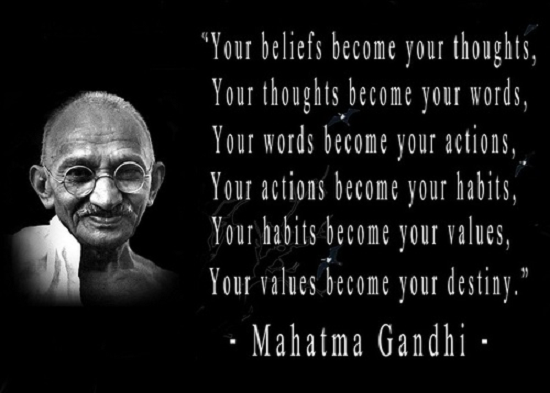
Mahatma Gandhi is frequently linked to the following proverb:
“Your beliefs become your thoughts. Your thoughts become your words. Your words become your actions. Your actions become your habits. Your habits become your values. Your values become your destiny.” – Mahatma Gandhi
The main point is powerful, regardless of whether you take the final word literally as “destiny” or as a reminder of the long-term effects of repeated decisions:
Your beliefs can have an impact on your actions.
So what is the question?
SEE ALSO: 33 Inspiring Abdul Kalam Quotes on Success, Dreams and Life Lessons
What do you believe about yourself?
Your Beliefs Become Your Thoughts
Your Thoughts Become Your Words
What Are Beliefs?
Beliefs are concepts or presumptions that we acknowledge as accurate or significant.
There are conscious beliefs.
In the background, others work silently.
You may consciously think, for instance:
“It takes practice to learn.”
“Goodwill is important.”
“Hard work has value.”
However, you could also have less evident beliefs like:
“I’m insufficient.”
“I’ll be rejected if I make mistakes.”
“It’s too late for me to make a change.”
“Successful individuals are just fortunate.”
“I consistently fail.”
These beliefs may have an impact on how you understand situations.
When two persons encounter the same setback, their reactions may differ greatly due to their differing worldviews.
One person considers:
“Since I failed, I ought to give up.”
Another considers:
“I need to understand why I failed.”
It is a comparable incident.
There is a difference in interpretation.
Furthermore, the interpretation may have an impact on what comes next.
Your Beliefs Become Your Thoughts
We are capable of seeing the world through the lens of our beliefs.
If you think you’re not capable of learning anything, your mind could keep coming up with ideas that confirm it:
“This is just too hard.”
“It will never make sense to me.”
“I am not as intelligent as others.”
Your desire to keep going may be diminished by those ideas.
In contrast, if you think:
“I can get better with practice,”
Your ideas might become more productive:
“I still don’t get this.”
“What do I learn?”
“What can I do differently?”
This does not imply that all issues are magically resolved by positive thinking.
It implies that your beliefs might affect how you perceive problems and decide how to respond to them.
SEE ALSO: The Silent Comeback Strategy After Failure
Your Thoughts Become Your Words
What you say is frequently influenced by what is on your mind.
When someone feels poorly of oneself on a regular basis, their language may start to reflect that.
As an example:
“I’m bad at everything.”
“I never get anything to work.”
“I’m unable to do this.”
“I am not respected by people.”
A poor self-perception can be reinforced by repeating remarks such as these.
Conversely, it is also possible.
A person who adopts a more positive outlook might start saying:
“I’ll work it out.”
“I can get better.”
“I can learn, but this is challenging.”
“I can try again, but I made a mistake.”
Success is not created by words alone.
However, the words we use on a regular basis can mirror and support our thought processes.
Your Words Become Your Actions
It’s significant to think.
However, thinking is insufficient on its own.
Thoughts must eventually turn into actions.
Consider a person who holds:
“I want to get healthier.”
If that conviction is accompanied by ideas like:
“I ought to start looking after myself better,”
Action is the next stage.
They could:
- Take regular walks.
- Make healthier meals.
- Enhance their sleeping schedule
- Study up on nutrition
- Establish reasonable objectives
The belief influences the thought.
The idea aids in the development of an intention.
The goal may result in action.
Additionally, repetitive behavior can develop into a pattern.
For this reason, altering your views might be beneficial, but beliefs must ultimately be accompanied by action.
SEE ALSO: The Benefits of Talking Less and Listening More: Why Listening Makes You a Better Communicator
Your Actions Become Your Habits
A single good deed does not change your life.
However, repeated behaviors can develop into habits.
Take a look at a book.
You’re not going to change your life by reading one page today.
Regular reading, however, can foster a lifelong love of learning.
In numerous contexts, the same idea holds true:
Repeated behavior → habit → pattern
Your everyday conduct counts because little things add up.
It’s not necessary to drastically change your life in a single day.
Instead, inquire
“What is one little thing I can do every time?”
Your Habits Influence Your Character
Habits are more than just natural behaviors.
Recurring actions can shape your personality.
A person may become more disciplined if they practice discipline on a regular basis.
A person may become more trustworthy if they consistently fulfilll their commitments.
A person who consistently evades accountability may grow accustomed to avoiding challenging circumstances.
This does not imply that a single behavior will always define your personality.
Individuals are capable of changing.
However, your repeated decisions are important.
One choice does not define your life.
Over time, thousands of decisions have shaped it.
SEE ALSO: 10 Characteristics of Shallow People (Psychology Explained with Real-Life Examples)
How Your Beliefs Can Influence Your Future
This is the deeper meaning behind the idea that beliefs shape destiny.
Your beliefs can influence:
Beliefs → Thoughts → Words → Actions → Habits → Direction
For example:
Limiting belief
“I’m not capable of learning new skills.”
↓
Thought
“There’s no point trying.”
↓
Action
You don’t start.
↓
Habit
You continue avoiding difficult learning experiences.
↓
Result
Your opportunities to develop the skill remain limited.
Now consider another belief:
Growth-oriented belief
“I can learn if I practice.”
↓
Thought
“I don’t understand this yet.”
↓
Action
You practice and seek help.
↓
Habit
You continue learning when something is difficult.
↓
Result
Your skills have an opportunity to improve.
The difference isn’t magic.
It is the difference between a belief that encourages avoidance and one that encourages constructive action.
SEE ALSO: Slam Book Quotes – Heart-Touching, Funny, Friendship & Motivational Lines
What Do You Believe About Yourself?
This may be the most important question in this entire article.
Take a moment and complete these sentences:
I am __________.
I am good at __________.
I am not good at __________.
I deserve __________.
I will never be able to __________.
I could become __________ if I __________.
Don’t immediately judge your answers.
Look for patterns.
You may discover beliefs that support you.
You may also discover beliefs that limit you.
What Are Limiting Beliefs?
A limiting belief is a presumption about the universe, other people, or yourself that limits what you think is feasible.
Typical instances consist of:
- “I’m not intelligent enough.”
- “I’m too old to begin.”
- “I’m not gifted.”
- “I’ll never succeed.”
- “No one will stand by me.”
- “I must be flawless.”
- “Everyone will judge me if I fail.”
- “People don’t succeed like me.”
- “Changing is too late.”
- “I’m simply unlucky.”
Certain beliefs could seem to be true.
However, a concept is not always objectively true just because it seems true.
Examining your views can therefore be beneficial.
How to Recognize a Limiting Belief
Consider this:
- Is there evidence to support this belief?
What real-world examples lend credence to it?
- Is there proof to the contrary?
Has the belief ever been false?
- Would I say this to a loved one?
Why do I tell myself that if not?
- Does this belief motivate me to take action or discourage it?
If a belief keeps making you give up, it could be worth looking into.
- Is this a definitive statement?
Keep an eye out for terms like:
Never, never, nobody, impossible, impossible
Seldom is life that absolute.
How to Change Limiting Beliefs
Changing a deeply held belief isn’t always easy.
You cannot simply say a positive sentence once and expect years of thinking to disappear.
Instead, try a gradual process.
H3: Step 1 — Identify the Belief
Write down the belief that is holding you back.
For example:
“I’m not capable of learning this.”
H3: Step 2 — Question It
Ask:
“Is this completely true?”
Maybe you’ve struggled before.
That doesn’t prove you are incapable of learning.
It may simply mean you haven’t found the right method or haven’t practiced enough.
H3: Step 3 — Create a More Balanced Belief
Instead of:
“I can do anything instantly.”
Try:
“I may struggle with this, but I can improve with practice.”
That’s more realistic.
H3: Step 4 — Take a Small Action
Put the new belief into practice.
If you believe you can become the best at something, spend 15 minutes practicing it.
Action provides real experience.
H3: Step 5 — Repeat
New thinking becomes more natural when you repeatedly practice it and reinforce it through behavior.
Positive Thinking Does Not Mean Ignoring Reality
When it enables you to react in a productive manner, positive thinking is beneficial.
When it necessitates pretending that issues don’t exist, it becomes useless.
Consider this:
“Everything will work out perfectly.”
is not always accurate.
An even more helpful idea is:
“This is a challenging situation, but I can concentrate on what I can manage.”
Blind optimism is not what that is.
Constructive thinking is what it is.
It is possible to accept reality and still feel that your activities have an impact.
Your Beliefs and Fear
Fear has a powerful effect on our perception of our own abilities.
You might consider:
“I’m scared I won’t succeed.”
Then that dread is transformed by your imagination into:
“I shouldn’t even attempt it.”
Avoidance is the outcome.
Failure, however, does not always indicate incapacity.
Failure can sometimes reveal information.
You discover:
- What didn’t function
- What has to be improved
- What you misinterpreted
- What you should practice
- What you ought to do differently the next time
There might still be fear.
Fearlessness is not a prerequisite for courage.
Acting despite fear is sometimes a sign of courage.
Your Beliefs About Failure Matter
Consider two beliefs.
Belief A:
“Failure means I’m not good enough.”
Belief B:
“Failure means I have something to learn.”
These beliefs can result in many different kinds of behaviors.
The first could promote avoidance.
The second might inspire introspection and a second try.
For this reason, improving one’s relationship with failure is crucial to personal development.
Failure does not have to be enjoyable.
You must take note of it.
Your Beliefs About Success Matter Too
Reaching a goal isn’t the only aspect of success.
If you think that:
“When everyone recognizes me, I’ll finally be happy,”
You may live your entire life seeking acceptance.
However, if you think
“Being better, adding value, sustaining meaningful relationships, and living in accordance with my values are all components of success,”
Your definition gets more expansive.
Think about:
For me, what does success really mean?
What you decide to do will depend on your response.
7 Beliefs That Can Support Personal Growth
Here are seven constructive beliefs you can practice.
1. I Can Learn
You don’t have to know everything today.
2. I Can Improve
Your current ability is not necessarily your permanent ability.
3. Mistakes Can Teach Me
A mistake can become useful when you examine it.
4. I Can Ask for Help
Asking for help isn’t automatically weakness.
5. I Don’t Need Everyone’s Approval
Your value doesn’t depend entirely on other people’s opinions.
6. Small Actions Matter
Consistent small steps can create meaningful change over time.
7. I Can Change My Direction
A past decision doesn’t have to control every future decision.
A Simple Daily Exercise to Change Your Thinking
Answer these questions for five minutes every day:
Question 1
What did I think of myself today?
Question 2
Was that a limiting or beneficial belief?
Question 3
What proof is there for it?
Question 4
What evidence contradicts it?
Question 5
How may one approach it in a more balanced manner?
Question 6
What little thing can I do tomorrow?
This transforms ambiguous motivation into useful introspection.
The Belief-to-Action Chain
Remember this simple framework:
BELIEFS
↓
THOUGHTS
↓
WORDS
↓
ACTIONS
↓
HABITS
↓
VALUES
↓
LIFE DIRECTION
Every occurrence in your life is not magically determined by your beliefs.
Unexpected things happen.
We are influenced by others.
Situations are important.
Luck is important.
Opportunities are important.
However, how you perceive and react to situations can be influenced by your beliefs.
And your answers are important.


2 pings